RFdiffusion, BindCraft or BoltzGen: which tool to design a VHH?
These tools are usually compared as if you had to pick one. Most of them do different jobs in the same pipeline, and only some are suited to an antibody scaffold at all. What each one does, which combination applies to a VHH, and the hit rates the published evaluations report.

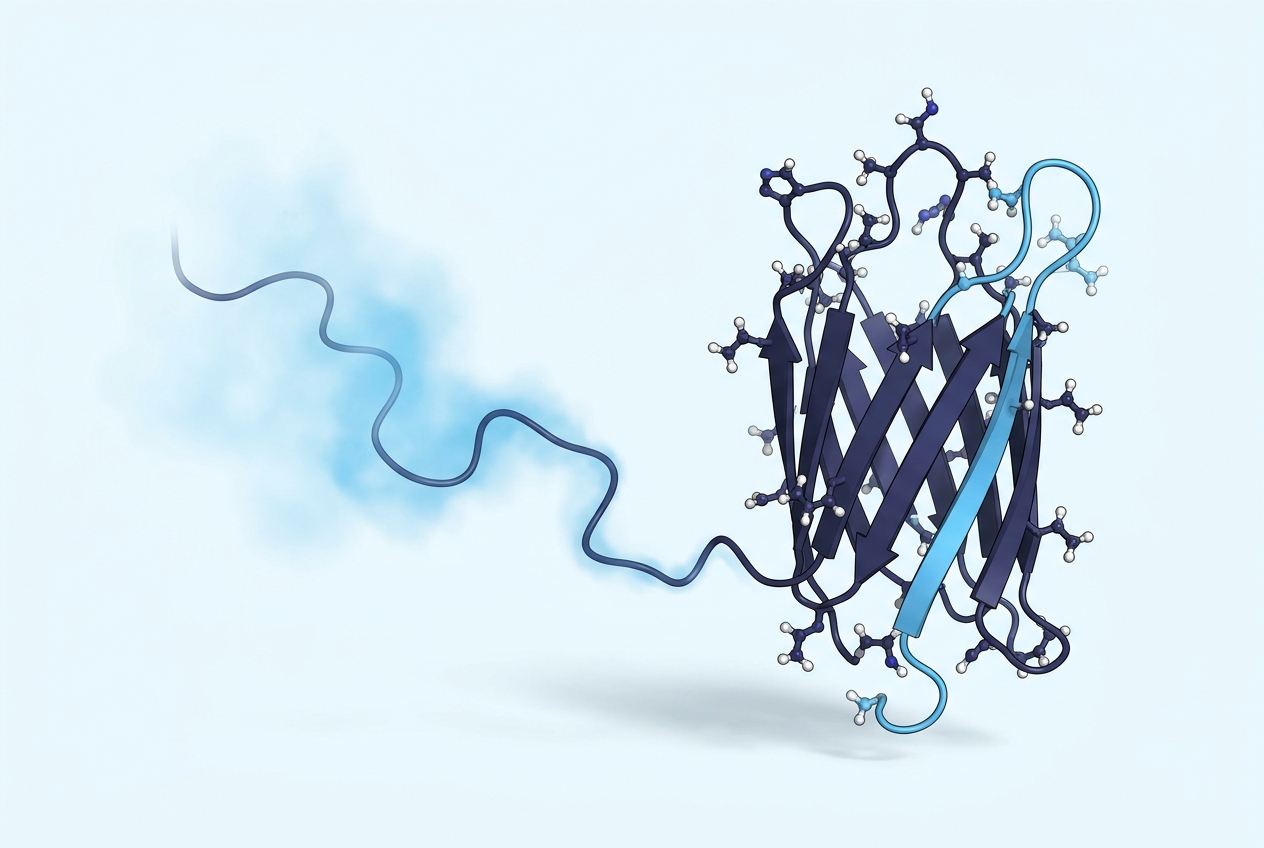
Mostly you use several of them, because RFdiffusion, ProteinMPNN, BindCraft and BoltzGen occupy different stages of the same pipeline rather than competing with one another. Asking which to use for a VHH is really asking two questions: which stage you are at, and whether your scaffold is an antibody or a free-form protein. That second point decides more than anything else, since designing a miniprotein binder and designing CDR loops on a VHH framework call for different tools entirely. What follows is what each one does, the combination that applies to a single-domain antibody, and the hit rates that the published evaluations actually report.
The four stages RFdiffusion and its neighbours divide between them
Almost every current workflow has the same shape, whatever tools happen to fill it:
- Stage one, the target structure: an experimental structure or a predicted model, together with a decision about which site to engage. Nothing downstream can be better than this input, which is why site selection counts as a piece of work in its own right.
- Stage two, backbone generation: producing a three-dimensional shape complementary to the chosen site. This is the generative step.
- Stage three, sequence design: given that backbone, choosing the amino acids that will fold into it and make the intended contacts. This is the inverse folding problem.
- Stage four, filtering: predicting the structure of each designed sequence independently, checking that it folds and docks as intended, then scoring, ranking and reducing the set to a shortlist.
Tools are often described as though they replaced one another, when in practice most of them occupy one of these four boxes and a few wrap several boxes into a single loop.
What RFdiffusion, ProteinMPNN, RFantibody and BindCraft each do
- RFdiffusion is a diffusion model that generates protein backbones, including backbones conditioned on a target and a specified binding site. It performs the generative step and produces no sequences of its own (Watson et al., Nature 2023, DOI).
- ProteinMPNN solves the inverse problem: given a backbone, it predicts a sequence likely to fold into it. The published method reports 52.4% native sequence recovery against 32.9% for Rosetta, and it runs in about a second per design (Dauparas et al., Science 2022, 378:49-56, DOI, reference located through PubMed). It is the standard partner to a backbone generator, and the RFdiffusion plus ProteinMPNN pairing is the most widely used combination in the field.
- RFantibody is the one that matters when the scaffold is an antibody. Built on a version of RFdiffusion fine-tuned for antibodies, it designs CDR loops on an antibody or VHH framework against a specified epitope. Its published validation demonstrated de novo VHHs binding four user-specified epitopes, as well as scFvs, with cryo-electron microscopy confirming the designed binding poses and a high-resolution structure confirming the atomic accuracy of the designed CDRs (Bennett et al., Nature 2026, 649:183-193, DOI, reference located through PubMed).
- BindCraft wraps generation, sequence design and filtering into a single loop that optimises directly against a structure prediction of the complex. It designs miniprotein binders, which makes it the right tool when the scaffold is free and the wrong one when the product has to be a VHH.
- BoltzGen is the most recent entry of the group and the one currently attracting most attention. It is presented as a general binder design model covering multiple modalities. We have found no independent experimental evaluation of it in the peer-reviewed literature, so we take no position on its performance and will revisit this when one appears.
- AlphaFold, Boltz and their successors sit in stage four. They are structure predictors used to check designs rather than design tools, and the quality of the filtering step depends heavily on them.
Which combination applies when the deliverable must be a VHH
If the deliverable has to be a single-domain antibody, the scaffold is fixed and that excludes most of the free-form options.
The practical combination is a target structure with a defined epitope, an antibody-conditioned generative step to design CDR loops on a VHH framework, a sequence design step for the loops and any framework positions that are in play, and a filtering step using independent structure prediction. RFantibody covers the generative part of that specifically, and we use it wherever the scaffold allows.
If the deliverable is simply a binder, with no requirement that it be an antibody, the field is wider and a miniprotein approach such as BindCraft becomes available. That choice has consequences well beyond the software, since a miniprotein is not a VHH in stability, immunogenicity profile, reformatting options or regulatory precedent. We treat it as a separate question rather than a tool preference.
What the published hit rates look like, target by target
This is the part that rarely appears in tool comparisons, and it is the part that decides how you run a campaign.
An independent evaluation of BindCraft for peptide binders reports the kind of numbers to expect. Against MDM2, 70 unique designs were generated, 15 were synthesised, and 7 bound with nanomolar affinity, with competition assays confirming the intended site. Against WDR5, 6 of 9 candidates bound at submicromolar affinity. Against PD-1 and PD-L1, none of the tested peptides showed detectable binding (Filius et al., ACS Chemical Biology 2025, 20:2991-2998, DOI, reference located through PubMed).
Three things follow from that single study:
- Hit rates are real but partial: roughly half the synthesised designs worked on two of the targets, which is a strong result by historical standards while remaining some way from a guarantee.
- The target matters more than the operator: the same tool, run competently throughout, produced binders on two targets and nothing at all on two others. That is one study on four peptide targets, so it indicates where the variable sits rather than settling it.
- The pipeline returns candidates either way: the PD-1 and PD-L1 campaigns produced designs that scored well enough to be worth synthesising and testing, and none of them bound. No amount of scoring would have revealed that in advance, which is the argument set out in our note on what a binding experiment proves.
The same pattern appears in the antibody work. Designs from the RFantibody validation bound in the tens to hundreds of nanomolar range, and an affinity maturation step then brought the best of them to single digits. The design step takes you to the right site with a working interaction, and the optimisation step is what takes you to the affinity.
Where the work sits once the models are running
Given that the tools are open and the weights are public, it is reasonable to ask what is left to do.
Three things remain, and the model is none of them:
- Deciding what to run, and against what: the choice of site, the choice of framework and the constraints the campaign has to respect are all settled before a single design is generated. A campaign aimed at an undesignable site will run perfectly and produce nothing.
- The filtering: generation is cheap while selection remains expensive. Deciding which fraction of thousands of designs is worth synthesising, on which criteria, and with which developability filters applied in parallel, is where most of the difference between campaigns sits. Carrying developability through this step instead of after it changes the shortlist.
- The experiment: expression and a binding assay, without which what you are delivering is a ranked list. A full cycle runs to six weeks from the antigen to candidate sequences and twelve weeks to binders validated in the laboratory, and the second half of that is laboratory work.
The tools themselves are easy to run and the tutorials are good, so the job that remains is deciding what to do with ten thousand designs once you have them.
Receive a feasibility study on your antigen - for free
Frequently asked questions
What is the difference between RFdiffusion and ProteinMPNN?
They are consecutive stages. RFdiffusion generates a backbone, meaning a three-dimensional shape. ProteinMPNN takes that backbone and predicts an amino acid sequence that will fold into it. You normally run both, in that order.
Can RFdiffusion design an antibody?
Not the base model, which generates free-form protein backbones. RFantibody, a pipeline built on an antibody-fine-tuned version of RFdiffusion, does design antibodies and VHHs against a specified epitope, and its validation is published in Nature.
Is BindCraft better than RFdiffusion?
They are not substitutes. BindCraft wraps generation, sequence design and filtering into one loop and targets miniprotein binders. RFdiffusion is a generative step usually paired with ProteinMPNN. If your product must be an antibody, neither is the direct answer and RFantibody is.
Do you need a GPU cluster to run these tools?
Generation and filtering are GPU-intensive, and a realistic campaign means thousands of designs rather than a handful. Running a single demonstration design on a hosted service is accessible to anyone. Running a campaign is a different scale of resource, which we cover separately.
Which tool do you use?
We use the published tools, chosen per campaign, with RFantibody where the scaffold is a VHH. The model is not the part we consider proprietary. Site assessment, the filtering criteria and the validation protocol are where our work sits.
Are these tools free?
The main ones publish their source code and weights on GitHub, and several are available through hosted services. Licences differ and are worth reading before commercial work: BindCraft, for one, installs PyRosetta, which requires a separate licence for commercial use. What limits a campaign is therefore the compute behind the tools, the judgement applied to filtering, and the laboratory capacity to test what comes out, rather than access to the tools themselves.
Have a target and want to know whether it suits a design campaign?
Receive a feasibility study on your antigen - for free