What is antibody developability, and when should you assess it?
Developability is whether a binder can be produced, formulated and dosed, as opposed to whether it binds. Most programmes assess it after a candidate is chosen. Applying the same filter during selection costs nothing extra and removes the failures that are expensive to discover late.

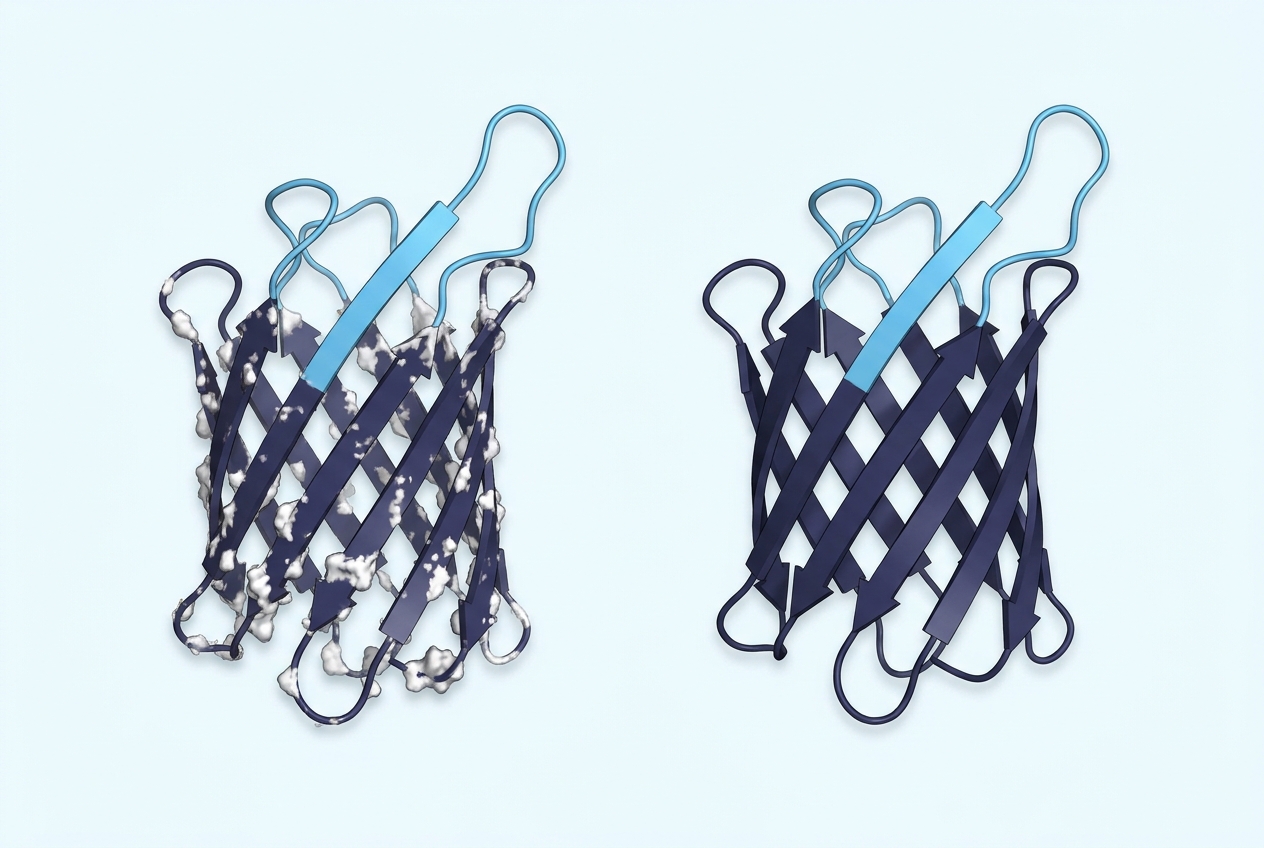
Antibody developability is the set of properties that decide whether a binder can be produced, purified, formulated, stored and dosed, as distinct from whether it binds its target. A candidate with excellent affinity that aggregates at concentration, expresses poorly or carries a chemical liability in a CDR is not a candidate. Most programmes assess developability after a lead has been selected, which is the point at which fixing anything is expensive. Assessing it during selection instead is what developability by design means.
What antibody developability covers
The term is used loosely, so it is worth setting out what sits inside it. These are the properties that determine whether a molecule survives the path from laboratory to product:
- Expression and yield: whether the sequence can be produced in the chosen system at a titre that makes the programme viable.
- Solubility and aggregation: whether the molecule stays monomeric at the concentrations required for formulation. Aggregation is the classic developability failure and the one most often discovered late, because it appears at concentration and a dilute binding assay will not reveal it.
- Thermal and conformational stability: whether the molecule tolerates the temperatures and the handling involved in manufacturing, shipping and storage.
- Chemical liabilities: the sequence motifs that degrade over time, among them deamidation sites, isomerisation sites, oxidation-prone residues, unpaired cysteines, and N-linked glycosylation sequons where they are unwanted. These matter most when they sit inside a CDR, because degradation then alters binding and compromises the function itself.
- Specificity and polyreactivity: whether the molecule binds things it should not. Surfaces carrying concentrated hydrophobic or positively charged patches tend towards non-specific binding, and this behaviour is written into the sequence rather than introduced by the preparation.
- Immunogenicity risk: whether the sequence contains elements likely to provoke an anti-drug antibody response, which for a non-human scaffold depends partly on the framework and partly on the designed loops.
- Pharmacokinetic behaviour: half-life, clearance route and biodistribution. For a single domain these are dominated by size, which is discussed in our comparison of antibody formats.
Why antibody developability is usually assessed too late
The conventional sequence is straightforward and almost universal: binders are generated (for example through established methods like immunisation or phage display), ranked by affinity, and a lead is selected, after which developability is assessed on that lead and whatever can be repaired is repaired.
By the time the assessment runs, the decision it should have informed has already been taken. A lead has been chosen, a cell line may be under way, an assay has been built around the molecule, and a timeline has been communicated. Discovering an aggregation problem at that point leaves three options, none of them good: engineer the liability out and risk the affinity that drove the selection, return to the panel and lose the quarter, or carry the problem forward and meet it again during formulation.
The same work, performed in a different order, removes the problem.
What is predictable from sequence and structure, and what is not
A useful share of developability is visible in the sequence and the structure, which is what makes early filtering possible at all.
Chemical liability motifs are the clearest case: a deamidation site in CDR2 is a pattern in the sequence, found by inspection, with no prediction involved. Charge distribution, surface hydrophobicity and predicted aggregation-prone regions are computed from a structural model and have been shown to correlate with experimental behaviour. Immunogenicity risk can be estimated from framework composition and predicted peptide presentation.
Published profiling methods formalise this. The Therapeutic Antibody Profiler derived guideline ranges for conventional antibodies by computing biophysical descriptors across therapeutic antibodies that had reached post-phase-I clinical stage, so that a new candidate can be positioned against them (Raybould et al., PNAS 2019, DOI, reference located through PubMed). The same Oxford group later published the Therapeutic Nanobody Profiler, which applies the approach to single domains, with guideline values derived from the 36 nanobody-based drugs that have reached clinical stage and tested against experimental data on 108 nanobodies (Gordon et al., Communications Biology 2026, DOI, reference located through PubMed). The distinction matters, because antibody descriptors are not suitable for direct application to single domains. That point is developed in our note on why antibody programs fail.
Two limits apply to all of it. These methods flag rather than decide: a candidate outside a guideline range is one to examine before it is ruled out. And a prediction is not a measurement, which is why thermal stability, long-term aggregation and real expression yield still have to be measured, as discussed in our note on what a binding experiment proves.
Carrying two criteria through the campaign instead of one
The change is to carry two criteria through the campaign instead of one.
For a designed molecule this is close to free, because the candidates exist as sequences and structures before anything is synthesised. Scoring them on developability descriptors at the same time as on predicted binding costs compute. The shortlist that goes forward to expression has already been filtered on both, so the attrition happens where it is cheap.
It also changes what happens when the two criteria disagree. The candidate with the best predicted interface will sometimes carry a liability that the next three candidates do not, and whether that information arrives during selection or after it determines whether you are making a choice between candidates or managing a problem on a single one.
For a discovered molecule the same logic applies with more friction, since the panel comes from a repertoire or a library and the sequences are whatever was selected. Profiling the panel before choosing a lead is still better than profiling the lead.
The four points at which the assessment pays for itself
- At target and site selection: a site that forces a highly hydrophobic paratope will tend to produce candidates with solubility problems, so developability can already be weighed before any binder exists. This belongs with epitope choice.
- During candidate selection: the computable descriptors, applied to the whole set before the shortlist is drawn.
- At validation: expression and a first specificity check, measured on the shortlist rather than predicted.
- Before scale-up: the full experimental panel on the lead and its backup, covering thermal stability, accelerated stability, aggregation at concentration, and specificity against a counter-screen. Most teams already run this assessment, and it works considerably better when it confirms a candidate that has already been filtered than when it examines one that has not.
A programme that carries the computable filter from the start should also hand you the resulting assessment as well as the sequences. With the EVOBodies™ platform at Immunochem, the developability panel is reported alongside the candidate sequences at week six, and the expression and binding validation is included in the twelve weeks to validated binders.
Receive a feasibility study on your antigen - for free
Frequently asked questions
What does antibody developability mean?
It means everything that determines whether a binder can become a product: expression yield, solubility, aggregation behaviour, thermal stability, chemical degradation liabilities, specificity, immunogenicity risk and pharmacokinetics. It is separate from affinity, and a candidate can be excellent on one and unusable on the other.
When should antibody developability be assessed?
As early as the molecules exist as sequences. The computable part can be applied to an entire candidate set before synthesis, which turns developability into a selection criterion rather than a later obstacle. The experimental panel still runs before scale-up.
Can developability be predicted from sequence alone?
Partly. Chemical liability motifs are read directly from the sequence. Aggregation propensity, surface hydrophobicity and charge distribution need a structural model and are predictions rather than measurements. Thermal stability and real expression yield have to be measured.
Are the metrics the same for nanobodies and conventional antibodies?
No, and this is a frequent error. Descriptor ranges derived from conventional antibodies do not transfer to single domains, because the structural basis differs: no pairing interface, a different framework and a longer CDR3. A nanobody-specific method exists, and the antibody version is not suitable for direct application to a single domain.
Does designing for developability cost affinity?
It constrains the search, which is not the same as costing affinity. Applied during selection, it mostly changes which of several comparable candidates goes forward. Applied as a repair on a chosen lead, it does risk affinity, which is the argument for the earlier timing.
Do you provide a developability assessment with the sequences?
Yes. The candidate sequences we deliver come with a developability assessment covering aggregation, expression and specificity risk, alongside the binding data from the validation round.
Want your candidates filtered on developability before you choose one?
Receive a feasibility study on your antigen - for free