What is a nanobody, and when is a designed one better than an immunised one?
A nanobody is a single antibody domain of roughly 15 kDa, naturally produced by camelids. What it is, how it differs from a conventional antibody, what it does that an IgG cannot, and the point at which designing one becomes a better route than immunising an animal for it.

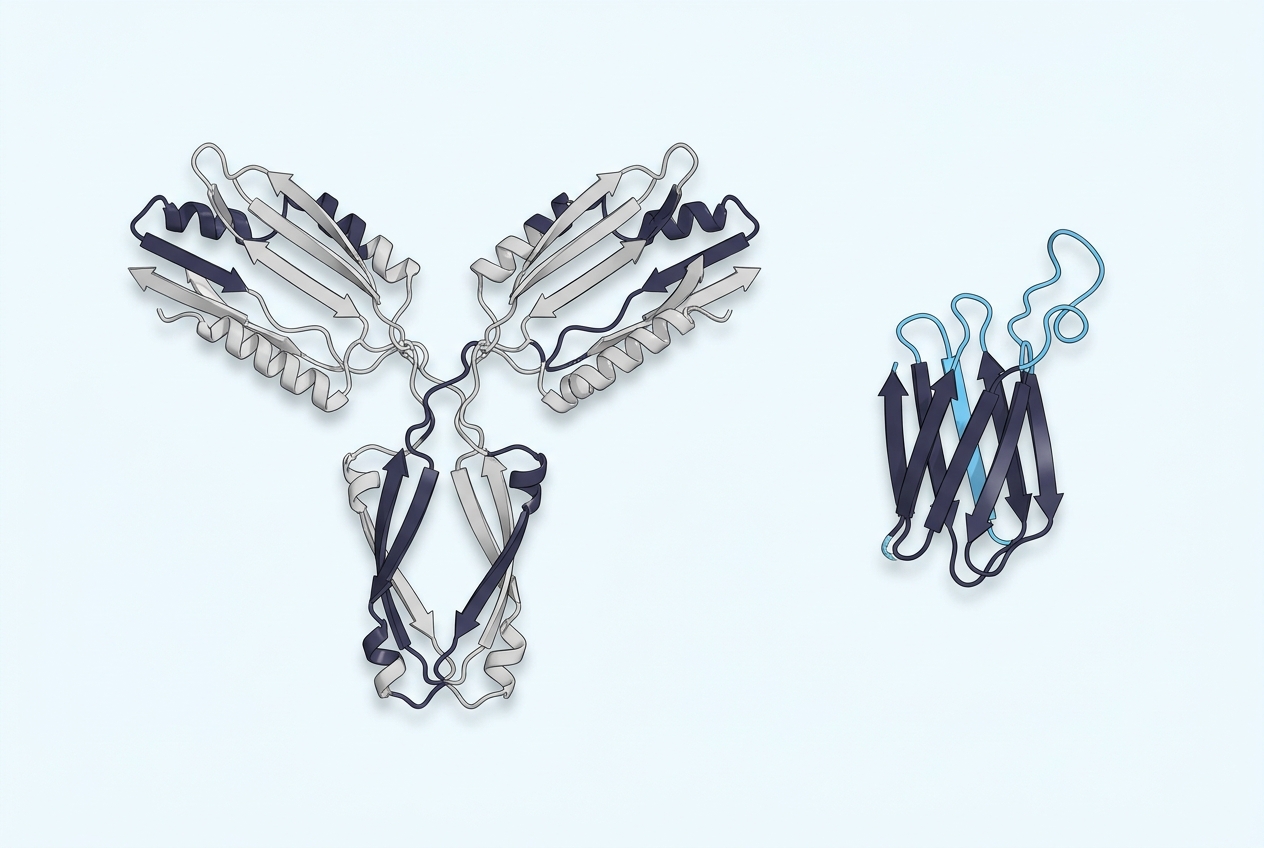
A nanobody is a single antibody domain of roughly 15 kDa that binds an antigen on its own, without the light chain a conventional antibody needs. It comes from the heavy-chain-only antibodies that camelids produce alongside ordinary ones, and the isolated domain is also called a VHH or a single-domain antibody. Being one tenth the mass of an IgG, it reaches sites a full antibody cannot, tolerates heat and pH that would denature one, and can be expressed in bacteria or yeast. For most teams the open question is how to obtain a nanobody against their target, and that is where the choice between immunising an animal and designing the sequence now matters.
Single-domain antibody, VHH, nanobody: three names for one molecule
The three terms are used interchangeably in the literature and in supplier catalogues, which causes more confusion than it should.
- VHH is the precise term: the variable domain of a camelid heavy-chain-only antibody. It names the domain.
- Single-domain antibody, written single domain antibody as often as not and shortened to sdAb, is the functional category: any antibody fragment that binds through one domain rather than a paired VH and VL. It includes the camelid VHH and the shark VNAR.
- Nanobody entered the field as a commercial name and has become the common usage. It is a registered trademark of Ablynx N.V., a Sanofi company, which is why VHH and single-domain antibody are the terms to use when precision matters.
A VHH antibody and a single-domain antibody of camelid origin are therefore the same molecule described at two levels: the domain and the class it belongs to. This note uses single-domain antibody and VHH antibody interchangeably, and reserves nanobody for the common usage.
What a nanobody is, structurally, and why it holds together alone
A conventional antibody is built from four chains: two heavy and two light, paired so that a VH domain and a VL domain together form the binding site. Camelids, meaning camels, llamas, alpacas, vicuñas and guanacos, also produce a second class of antibody that has no light chains at all and no CH1 domain. Binding is carried by a single variable domain on the heavy chain, the VHH.
Isolate that domain and you have a nanobody: around 120 amino acids, 12 to 15 kDa, one chain, no pairing interface. Cartilaginous fish produce an equivalent architecture, the VNAR, through a separate evolutionary route.
Three structural consequences follow, and between them they explain nearly everything a nanobody does differently:
- There is nothing to come apart: a paired format holds its binding site together across an interface, whereas a single domain has no interface to lose. This is the root of its stability and of the ease with which it can be fused, multimerised or reformatted.
- The CDR3 loop is longer: in camelid VHHs this loop is extended relative to a human VH and often folds back over the surface that would otherwise face a light chain. The result is a convex, protruding paratope, where an IgG typically presents a flat or grooved one.
- The framework is more soluble: the residues that would sit at the VH-VL interface are replaced by hydrophilic ones, which is why the domain remains stable alone in solution instead of aggregating.
What a single domain buys you: tissue access, stability, reformatting
The convex paratope reaches concave sites: enzyme active sites, receptor binding pockets, clefts on a viral surface. These are the sites where a large paratope has no room, and it is a functional capability rather than a convenience.
The small size means deeper and more even penetration into dense tissue and into tumours, and it means fast clearance, since anything below roughly 60 kDa is filtered by the kidney. Whether that is a feature or a problem depends entirely on the application. For an imaging tracer it is exactly what you want. For a systemic therapy dosed every few weeks it is the thing you have to engineer around, usually by fusing to an Fc or to an albumin binder.
Stability is the property most often cited and the one most useful day to day. Nanobodies tolerate elevated temperatures, broad pH ranges and chemical denaturation, and many refold after unfolding. That makes them practical as reagents that survive shipping and handling, and as components of diagnostic assays that are not kept cold.
Expression is cheap. One chain with no pairing requirement expresses in E. coli, in yeast, or in a cell-free system, rather than requiring mammalian culture.
What a nanobody does not give you is effector function or a long half-life, because both come from the Fc region that an isolated domain does not have. Either can be added back, and the trade-offs of doing so are set out in our comparison of VHH, scFv and IgG formats.
How a nanobody is obtained today: llama, library, or design
Three routes exist, and they differ in what they can promise:
- Immunisation of a camelid: an alpaca or llama is immunised, its B-cell repertoire is captured, and binders are recovered by phage display. This is the established route, it works, and the binders obtained have been through affinity maturation inside a living immune system, which is an advantage. It also takes months, requires animals, and leaves you no control over which epitope the immune system decides to respond to. Self-proteins and toxins make poor candidates, for opposite reasons: one is invisible to the immune system and the other is dangerous to inject.
- Synthetic library screening: a large library built on a fixed VHH framework is screened in vitro, with no animal involved. It is faster and reproducible, while remaining a selection process that is blind to epitope in the same way, since what you obtain is whatever binds rather than what you specified.
- Computational design: the sequence is designed against a structure of the target, at an epitope you name, with no immune repertoire, no library and no selection step. This route became credible only recently, and the reason is set out below.
When to design a nanobody and when to immunise for one
A 2026 paper in Nature from the Baker laboratory demonstrated de novo design of VHHs against user-specified epitopes, with cryo-electron microscopy confirming the intended binding pose for designs against influenza haemagglutinin and Clostridium difficile toxin B, and a high-resolution structure confirming atomic accuracy of the designed CDRs. Initial designs bound at tens to hundreds of nanomolar, and affinity maturation brought them to single-digit nanomolar without loss of the intended epitope (Bennett et al., Nature 2026, 649:183-193, DOI, reference located through PubMed).
That result sets the boundary. In the published work, designs reached the chosen site and the intended pose was confirmed by cryo-electron microscopy for the structures that were solved. Affinity out of the first round depends on the target and on the method: designed miniprotein binders have been reported at nanomolar affinity straight from the design stage, with no screening or optimisation step, although that work was not on antibodies (Pacesa et al., Nature 2025, 646:483-492, DOI, reference located through PubMed), while other campaigns start weaker and gain from a maturation round.
The choice between routes therefore depends less on which method is better in general than on which constraint you are working under:
- Immunisation suits a foreign, immunogenic protein, a timeline measured in months rather than weeks, a programme where affinity matters more than epitope control, and a setting where animal work raises no issue for you.
- Design suits a programme that needs a named epitope rather than whichever one the animal responds to, a target that is a self-protein, a toxin or otherwise unsuitable for injection, a requirement to stay clear of a sequence someone else has patented, a wish to apply developability filtering before synthesis, or a decision not to use animals.
Through the EVOBodies™ platform, Immunochem works exclusively on the design route, with timelines of six weeks from the antigen to candidate sequences and twelve weeks to binders validated in the laboratory. The validation step matters here, because a designed sequence remains a prediction until an experiment says otherwise, which is the subject of its own note.
Receive a feasibility study on your antigen - for free
Frequently asked questions
What is the difference between a nanobody and an antibody?
A conventional antibody is roughly 150 kDa and built from four chains, with its binding site formed by a paired VH and VL. A nanobody is a single variable domain of about 15 kDa that binds on its own. The nanobody reaches recessed sites, tolerates harsher conditions and expresses in bacteria. The conventional antibody circulates for weeks and carries effector function, neither of which a bare nanobody has.
Are nanobody, VHH and single-domain antibody the same thing?
In practice yes, with one caveat. VHH is the precise term for the variable domain of a camelid heavy-chain-only antibody. Single-domain antibody, abbreviated sdAb, is the general category, which also covers shark VNARs and engineered human domains. Nanobody is a registered trademark of Ablynx N.V., a Sanofi company, and is widely used as though it were generic. Most of the literature uses the three interchangeably.
How big is a nanobody?
Around 12 to 15 kDa, roughly 120 amino acids, about 4 nanometres in its longest dimension. That is close to one tenth the mass of an IgG.
Can a nanobody be made without immunising an animal?
Yes, by two different routes. Synthetic libraries are screened in vitro on a fixed framework. Computational design produces sequences against a structure of the target without any library or repertoire. We use the second, and we never run immunisation, of any species.
Do nanobodies work as drugs?
Yes. Caplacizumab, approved for acquired thrombotic thrombocytopenic purpura, is a nanobody-based therapeutic, and its phase 3 trial (HERCULES) is published (Scully et al., New England Journal of Medicine 2019, 380:335-346, DOI, reference located through PubMed). Others are in clinical development across oncology, inflammation and imaging. Most therapeutic constructs add a half-life extension, because a bare single domain clears too quickly for systemic dosing.
Are nanobodies immunogenic in humans?
The camelid VHH framework is close to the human VH3 family, which makes it less immunogenic than most non-human formats, though not inherently non-immunogenic. Humanisation of the framework is routine where it matters. Immunogenicity risk is one of the properties that can be assessed computationally before a sequence is made.
Working out whether your target suits a designed nanobody?
Receive a feasibility study on your antigen - for free