Antibody generation against a toxin or a self-protein, without immunisation
Two classes of target defeat immunisation for opposite reasons. A self-protein is invisible to the immune system, a toxin is dangerous to inject. Neither constraint applies when the sequence is designed from a structure, and this is what changes and what does not.
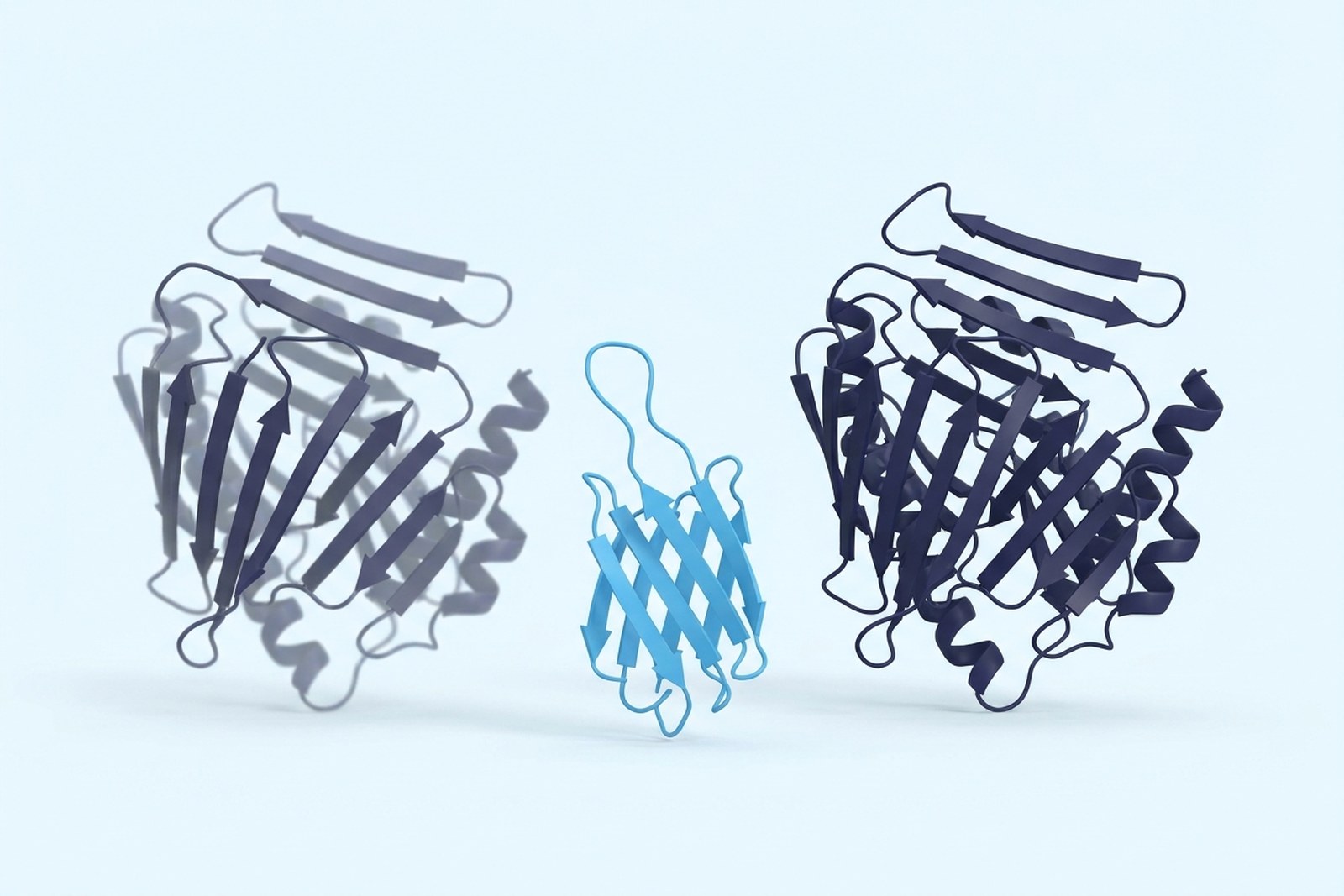
Yes. Antibody generation against a self-protein or a toxin is one of the clearest cases for designing the sequence computationally, because each of these two target classes defeats immunisation for a different reason. A self-protein is largely invisible to the animal's own immune system, so it mounts little or no response. A toxin provokes a response readily enough, but it cannot be injected safely, and the detoxification step that makes it safe will often destroy the very structure you needed the antibody to recognise. When the sequence is designed from a structure instead, neither of these obstacles arises, because no animal is involved at any point.
Why tolerance blocks antibody generation against a self-protein
An immune system that attacked its own proteins would cause disease, so during development it eliminates or silences the B cells that react against them. The result is immune tolerance.
Immunise an animal with a protein that closely resembles one of its own and the response is weak, narrow or absent. The usual workarounds all carry a cost:
- Use a host whose own version of the protein differs: if the host's own orthologue is different enough from the human protein, the human protein may be foreign enough to provoke a response. This works on some targets and fails on highly conserved ones, where the two orthologues are too close for the immune system to separate them.
- Immunise against a fragment or a peptide: tolerance is easier to break this way, but the antibodies obtained frequently bind the peptide while ignoring the folded protein, which is a well-documented and expensive form of failure.
- Use a knockout animal: this is effective, and it is available only where such an animal already exists for your target.
None of this means a binder against a self-protein cannot reach the clinic. Caplacizumab targets von Willebrand factor, a human plasma protein, and was approved on the strength of the HERCULES trial in acquired thrombotic thrombocytopenic purpura (Scully et al., New England Journal of Medicine 2019, 380:335-346, DOI, reference located through PubMed). What blocks these targets is the generation step rather than anything about the target class itself.
The deeper difficulty is that tolerance is strongest exactly where the biology is most interesting. A protein that has been highly conserved through evolution has been conserved because it performs an essential function, which also means that the animal you are immunising carries a nearly identical version of it. Its immune system therefore treats the injected protein as one of its own and declines to respond. The more important the target, the less willing the animal is to help.
Why toxicity blocks antibody generation against a toxin
With a toxin the difficulty is reversed. The animal would respond perfectly well, and it is the handling of the material that stands in the way, for four distinct reasons:
- The material is hazardous: producing, handling and injecting an active toxin requires containment appropriate to its classification, and that requirement runs across the whole chain rather than applying to the injection alone.
- Detoxification changes the molecule: the classical route is to immunise against a toxoid, an inactivated form of the toxin. Inactivation frequently alters the structure, and antibodies raised against an altered conformation may fail to recognise the active one. For a neutralising antibody, the active conformation is precisely what matters.
- The informative site is often the dangerous one: neutralisation usually requires binding the catalytic site or the receptor-binding region, and these are exactly the regions that detoxification modifies.
- Animal use is a constraint in its own right: the route requires an animal, an approved protocol and ethical review, whatever form of the toxin is injected.
What changes when the sequence is designed rather than selected
The route itself is set out in our comparison of phage display and computational design. Applied to these two classes of target, three things change:
- Nothing is injected: no immune system is involved at any stage, so neither the tolerance problem nor the hazard problem arises. The two constraints that dominate the conventional route fall away.
- The antigen does not have to be produced, because the design works from a structure: for a toxin this removes the containment problem from the generation step entirely. Material is still needed for the validation assay, in small quantity and at the end of the process, and that requirement is real.
- The epitope is chosen rather than accepted: this matters more on these targets than anywhere else. On a self-protein you frequently need to engage a region that differs from a closely related family member. On a toxin you need the catalytic or receptor-binding site, whereas immunisation will favour whichever surface happens to be most immunogenic. Neither of these requirements can be communicated to an animal. Site selection is covered in our note on choosing which site to target.
What stays exactly as hard as before
- Specificity becomes the central problem: when the target is a toxin or a self-protein, removing tolerance makes the binder easier to generate without making it easier to make selective. A binder raised against a self-protein will meet that protein everywhere it is expressed, and it may meet close homologues as well. Where the target belongs to a family whose members share 80 or 90% of their sequence, the residues that distinguish them have to fall inside the site that the binder engages. If they do not, the binder will recognise both proteins equally, and the project has failed however tightly it binds. The site is therefore selected to contain those distinguishing residues wherever they exist, which improves the odds without guaranteeing the outcome, and the selectivity actually obtained has to be demonstrated experimentally against the homologues concerned.
- A structure is required: where there is neither an experimental structure nor a model you can trust, there is no design. For well-studied toxins this is rarely an obstacle, since many of them are characterised in detail. For an orphan self-protein it can be the constraint that blocks the project altogether.
- Flexible regions remain hard: designing against a single conformation of a mobile region produces candidates whose binding may not survive contact with the real molecule. This is a limitation of the method itself, and it applies whatever the class of target.
- Validation still needs the real molecule: at some point a binder has to be tested against the actual target. For a toxin this means working with the material under appropriate containment, which is a question for whoever holds it. We express candidates in a cell-free system and test binding by ELISA, and the scope of what that establishes is set out in what a binding experiment proves.
- Neutralisation is a separate question from binding: binding the catalytic site is a hypothesis about function. Whether the binder actually neutralises the toxin is established by a functional assay, which sits downstream of the design work.
Other target classes where immunisation struggles
The same reasoning extends to several other classes of target, subject in every case to the same prerequisite, which is a structure reliable enough to design against:
- Membrane proteins and GPCRs, where the obstacle is producing the antigen in a native conformation rather than obtaining an immune response. Design works from a structure, and structural coverage of these families has expanded considerably in recent years.
- Highly glycosylated targets, where glycans dominate the surface and the immune response is directed at them. A designed campaign can be aimed at the protein surface explicitly, provided the glycosylation pattern is known.
- Small peptides and haptens, which are too small to be immunogenic on their own and conventionally require conjugation to a carrier, a step that introduces artefacts of its own.
- Conserved pathogen epitopes, where the immunodominant regions vary from strain to strain while the conserved regions attract little immune attention. An immune response is directed by the immune system, whereas a designed campaign is directed by you.
Designing the antibody computationally, and validating it in the laboratory
AI-based antibody generation uses computational programs to design your antibody from the sequence and the structure of the antigen, with the binding site chosen deliberately rather than left to the immune system. No animal is immunised at any stage, which is what removes the tolerance constraint and the hazard constraint described above.
Whatever the origin of the sequence, a wet-lab validation step is necessary in every case. A designed sequence remains a prediction until it has been expressed and tested against the target, and no computational score replaces that experiment. A serious provider will tell you how many candidates are expressed, what proportion of them binds, and what the assay does and does not establish.
At Immunochem, the EVOBodies™ platform gives you access to AI-based antibody generation together with wet-lab validation. We are based in Belgium, we design single-domain antibodies and conventional antibodies entirely computationally, and we run no immunisation of any species. Every project, including self-proteins and toxins, starts with a free feasibility study covering the structure, the site you need engaged, and our assessment of whether it is designable. Six weeks from go-ahead to candidate sequences, twelve weeks to binders validated in the laboratory.
Note that we do not work with controlled agents and we do not hold hazardous material. Where validation requires the active molecule, that work sits with you or with a laboratory equipped for it.
Receive a feasibility study on your antigen, for free
Frequently asked questions
Why is it hard to raise antibodies against a self-protein?
Immune tolerance. B cells reactive against the host's own proteins are deleted or silenced during development, so immunising with a protein closely resembling one of the animal's own produces a weak or absent response. The effect is strongest for highly conserved proteins, because the animal carries a nearly identical version of them.
Can you make an antibody against a toxin without immunising?
Yes. Design works from the structure of the toxin rather than from the molecule itself, so no active material is injected, and the catalytic or receptor-binding site can be targeted directly instead of whichever surface survives detoxification.
Does computational design solve the specificity problem on self-proteins?
No. What it changes is where the problem sits. Tolerance no longer limits which binders can be generated, while cross-reactivity with the target's close relatives remains the central risk. It is addressed by selecting a site that contains the discriminating residues and by testing candidates against a counter-screen.
What do you need to start?
A structure, experimental or predicted, and an indication of the site you need engaged. For a self-protein, the close homologues that the binder must not recognise can help. The structure is the first thing the free feasibility study proposed by Immunochem examines, and it will say when confidence in it is too low to proceed.
Do you work with toxins directly?
We work from structures and we do not hold hazardous material. The design and the computational filtering need no physical toxin. Validation against the active molecule requires a laboratory equipped for it, which is a separate arrangement.
Where is Immunochem based?
Immunochem is based in Belgium and works with clients across Europe and beyond.
Have a target that immunisation has already failed on?
Receive a feasibility study on your antigen - for free