Phage display antibody discovery or computational design: which route?
One selects from diversity it already has, the other specifies what it wants. That difference decides epitope control, how much antigen you need, where your affinity comes from and what your provenance file looks like. A decision table rather than a verdict.

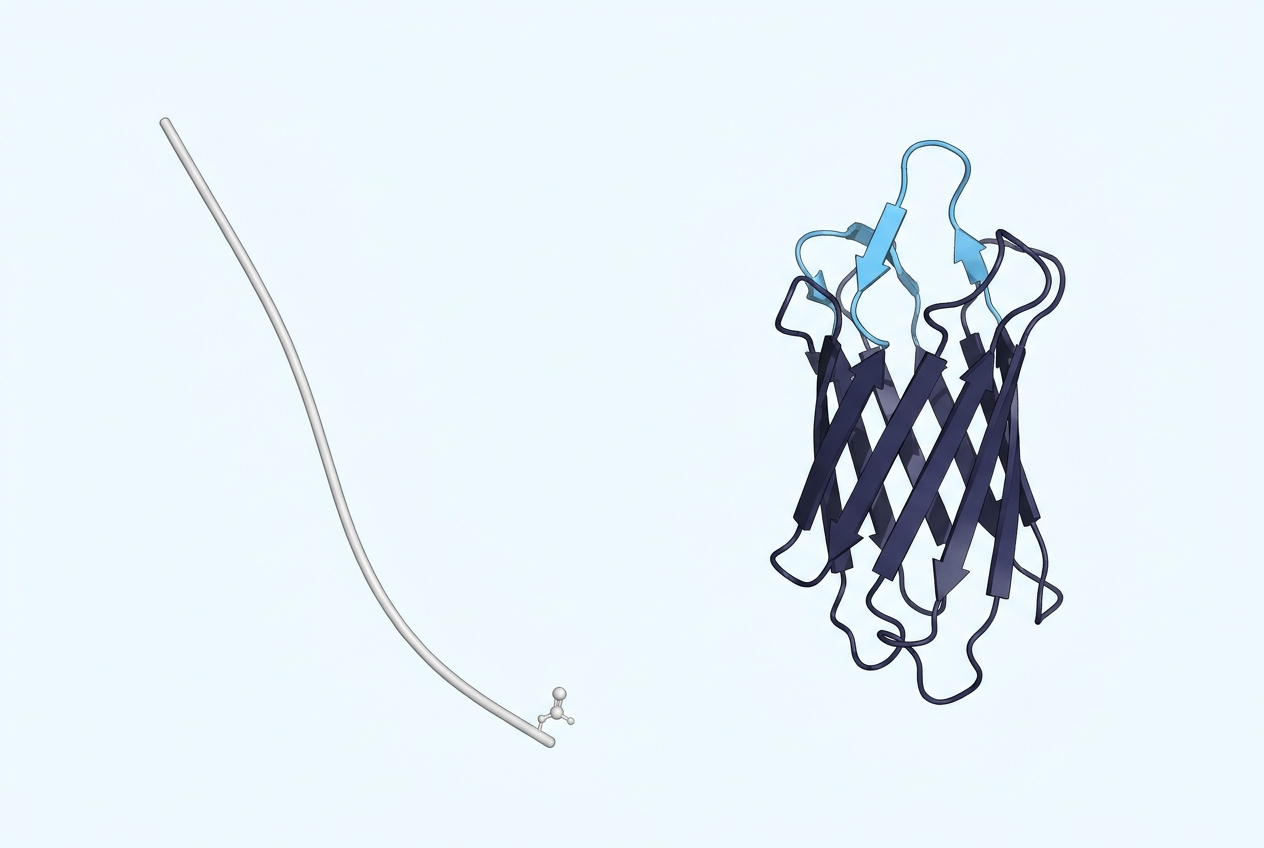
Phage display antibody discovery enriches binders out of diversity you already hold, whereas computational design specifies a sequence against a structure. Both can produce binders, but phage display has decades of approved antibodies behind it, while computational design has published experimental validation and no approved antibody yet. The choice between them has little to do with which is more modern and turns on four practical things: whether you need to choose the epitope, how much native antigen you can supply, where your affinity is going to come from, and what the provenance file has to look like. This note is the comparison, including the cases where display is the better route.
What phage display antibody discovery selects, and what design specifies
Phage display starts with a library, either immune, derived from an animal exposed to the antigen, or synthetic, built on a fixed framework with randomised loops. Each phage particle carries one antibody fragment on its surface and the gene encoding it inside. The library is exposed to immobilised antigen, non-binders are washed away, binders are eluted and amplified, and the cycle repeats. After several rounds the population is dominated by binders, which are then sequenced and characterised.
The mechanism is selection under a physical constraint, so what you get is whatever survived panning.
Computational design starts with a structure of the target and a chosen site. A generative model produces backbones complementary to that site, a sequence design model assigns amino acids, and an independent structure prediction filters the candidates that fold and dock as intended. Survivors are expressed and tested.
The mechanism is specification followed by verification: you get what you asked for, to the extent the models are right, and the experiment tells you which of those they got right.
The two routes side by side, criterion by criterion
| Phage display | Computational design | |
|---|---|---|
| Epitope control | Indirect, through antigen engineering and competition | Direct, the site is an input |
| Native antigen required | Yes, immobilised, in quantity | For validation only |
| Structure required | No | Yes, experimental or predicted |
| Typical starting affinity | Nanomolar, from enrichment | Tens to hundreds of nanomolar, before optimisation |
| Where affinity comes from | Library diversity plus panning rounds | A separate optimisation step |
| Self-proteins and toxins | Difficult or hazardous | No constraint, nothing is injected |
| Flexible or disordered targets | Workable | Poor, the model is one conformation |
| Provenance of the sequence | Library history, licensing to check | Design record, no third-party repertoire |
| Sequence distance from prior art | Not controllable during selection | Can be imposed as a design constraint |
| Developability | Assessed after selection | Can filter during selection |
| Animal use | Immune libraries yes, synthetic no | None |
| Maturity of the route | Decades, approved products | Recent, published experimental validation |
When phage display antibody discovery is the better route
Phage display is the better route when:
The target is a well-behaved, producible protein and what you need is the best binder you can get, with the epitope being a secondary concern. Enrichment over several rounds against real antigen optimises directly on the actual molecule rather than on a model of it.
The target is flexible, partly disordered or conformationally heterogeneous. Panning selects against whatever the protein really is in solution. A design campaign against one conformation of a mobile region produces candidates that bind the model.
You need a large, diverse panel quickly, for example for epitope binning or for a diagnostic pair where you need two binders that do not compete.
The structure is unavailable and cannot be predicted with confidence. Without a structure, design has no input.
Computational design is the better route when:
You must engage a named site. Blocking a specific interface, hitting an allosteric pocket, or avoiding an immunodominant region are all requirements that selection cannot be instructed to respect.
The antigen is difficult or impossible to produce in native form, but its structure is known. This is the case that most often decides the question, because antigen supply sinks more display campaigns than panning does.
The target is a self-protein, a toxin, or otherwise unsuitable for immunisation, which removes immune libraries from consideration.
Sequence distance from existing claims is a constraint, since identity to a published sequence can be designed against rather than discovered afterwards. This is the basis of our work on designing around an antibody patent.
Provenance has to be clean. A designed sequence has no library history and no third-party repertoire behind it.
Where the affinity comes from, and why the starting numbers differ
Comparisons usually become unreliable at this point, so the figures below are given with their sources.
In the RFantibody study, initial designs bound in the tens to hundreds of nanomolar range before any optimisation, and reached single-digit nanomolar after an affinity maturation step (Bennett et al., Nature 2026, 649:183-193, DOI, reference located through PubMed). Phage display antibody discovery from a good library routinely delivers nanomolar binders directly, because enrichment is itself an optimisation.
So design does not currently start where display ends. It gets to the right site with a working interaction, and the affinity comes from a subsequent step rather than from the generation step.
Anyone claiming otherwise is describing a single favourable campaign. The two routes put the optimisation in different places, and a programme should budget for it either way.
The constraints neither route escapes
Both produce candidates that have to be tested, and neither produces a usable molecule without an experiment. Display gives you enriched clones that still need characterising for affinity, specificity and developability. Design gives you ranked sequences that still need expressing and testing, which is why we run that step before delivering anything, as explained in our note on what a binding experiment proves.
Both also leave the downstream workflow intact. Functional characterisation, developability panels and preclinical work are the same either way, which is the point made in our map of where design fits in the discovery workflow.
Using both: design first, then display to mature
They are not exclusive, and the most effective programmes often use both.
A designed panel can be the input to a display-based maturation step, which puts specification at the generation stage and selection at the optimisation stage. The Nature work above used a related shape: designs were screened by yeast display, and affinity maturation was carried out separately, by continuous evolution in yeast rather than by a display round.
A display-derived binder can also be the input to a redesign, when the binder works but carries a developability liability or sits too close to someone else's sequence. That is a different entry point, and it is the one most of our patent work uses.
We run the design route only. We have no immunisation capability and no library, which is a constraint as much as a position, and it is why we say so when a target would be better served by display.
Receive a feasibility study on your antigen - for free
Frequently asked questions
Is phage display antibody discovery obsolete?
No. It remains the more reliable route for flexible targets, for producing large diverse panels, and for reaching high affinity directly. It has produced approved therapeutics and continues to.
Can phage display antibody discovery target a specific epitope?
Only indirectly. You can engineer the antigen to expose the region you want, pan in the presence of a competing antibody, or screen the output for the right competition profile. These work, and they are steering rather than specification.
Do you need an animal for phage display?
Not for a synthetic library, which is built in vitro. Immune libraries, which often give better starting affinity, require immunisation. We run neither, of any species.
Which route gives cleaner intellectual property?
Design, usually. There is no library, no third-party repertoire and no selection history to trace, and identity to published sequences can be measured and constrained during the design itself. A library route brings the licensing position of the library with it.
Can the two be combined?
Yes, and it is a sound pattern: design the panel, then run a selection step for affinity maturation. In the published validation of de novo antibody design, screening was done by yeast display and maturation by continuous evolution.
What if there is no structure of my target?
Then design has no input. A predicted model is often sufficient, and we will say when confidence in it is too low. Where no credible structure exists, display is the route.
Not sure which route your target calls for?
Receive a feasibility study on your antigen - for free