Does an AI-designed antibody actually bind?
A design pipeline always returns something. It returns its best candidates whether or not any of them work, because a score is a ranking and not a measurement. What computation can establish before synthesis, what it cannot, and what a binding experiment actually proves.

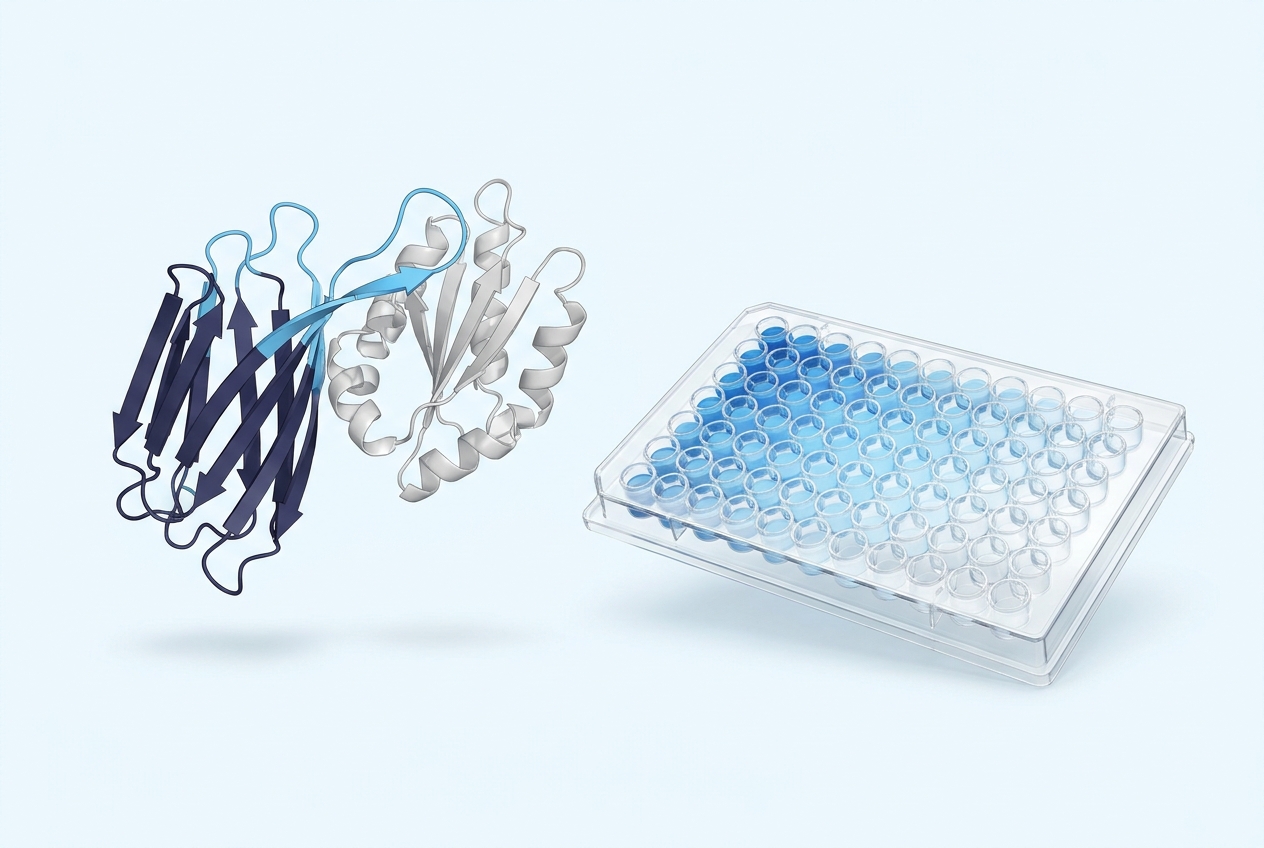
Some do, depending on the target and the method, and the only way to know is to express and test. What computation alone cannot tell you is which ones, and anyone promising that it works every time is selling you something rather than describing a method. An AI-designed antibody is a hypothesis with a score attached, and the score ranks candidates against each other rather than predicting whether any of them works. A design pipeline will return its best sequences whether or not a single one binds, because returning the top of a ranked list is what it does. That is the gap a binding experiment closes, and it is why we express and test candidates before delivering them. What follows is what computation can establish, what it cannot, and what an experiment actually proves.
What a design score measures, and what it cannot
Every stage of a design pipeline produces numbers. A structure prediction returns a confidence metric. A docking or interface calculation returns a predicted energy. A refolding check returns how well the designed sequence is predicted to adopt the backbone it was designed for.
All of these are comparative. They tell you that candidate 47 looks better than candidate 112 under the model. None of them tells you that candidate 47 binds, because the model was trained on structures that exist and is being asked about a molecule that does not yet.
Two failure modes follow, and both are routine.
- The pipeline always returns something: ask for the fifty best designs and you receive fifty designs, ranked, and the ranking carries the same confidence whether the underlying campaign was tractable or hopeless. An absence of binders never presents itself as an empty output.
- The metrics correlate with success without predicting it: designs that score well do succeed more often than designs that score badly, which is what makes filtering worth doing at all. Published pipelines report experimental success rates spanning roughly 10% to 100% depending on the target (Pacesa et al., Nature 2025, 646:483-492, DOI, reference located through PubMed). That spread is the real answer to how often design works, and it is why campaigns generate several candidates and test them instead of designing one and shipping it.
This is visible in the literature. The 2026 Nature paper demonstrating de novo VHH design against specified epitopes stopped short of declaring success on the design alone: it generated designs, screened them by yeast display, characterised what came through, and confirmed binding poses by cryo-electron microscopy. Initial designs bound at tens to hundreds of nanomolar and required an affinity maturation step to reach single-digit nanomolar (Bennett et al., Nature 2026, 649:183-193, DOI, reference located through PubMed).
In that work the experiment is a stage of the method rather than an afterthought appended to it.
What an AI-designed antibody campaign settles before anything is made
None of the limits above argues against designing computationally. What they argue for is precision about which questions the calculation settles, and several of them it settles well:
- Which site is targeted: this is the capability that separates design from discovery. You name the site and the campaign is aimed at it, which neither immunisation nor library screening allows. Whether the binder engages that site has to be shown experimentally.
- Sequence distance from prior art: identity to a claimed sequence is arithmetic rather than prediction. It is exact, and it can be imposed as a design constraint instead of being measured after the fact, which is the basis of our work on designing around an antibody patent.
- Developability liabilities: aggregation propensity, surface hydrophobicity, charge distribution, unpaired cysteines, deamidation and isomerisation motifs are all computable from sequence and structure, which makes them the properties that can be filtered before synthesis instead of discovered after selection. This is the subject of developability by design.
- Structural plausibility: whether a designed sequence is predicted to fold into the backbone it was designed for is an effective filter, and candidates that fail it are rarely worth making.
Every one of those is a property of the sequence itself. Binding is a property of an interaction, and that is where the model is weakest.
What cell-free expression and an ELISA add to a prediction
Shortlisted candidates are expressed in a cell-free system and tested by ELISA against the target. Cell-free expression is used because it goes from DNA to protein in hours rather than days, which is what makes it practical to eliminate candidates quickly. It is a screen rather than a test of manufacturability, which is established later in whichever production system you intend to use.
Four things change once the result comes back:
- Binding becomes a measurement: the candidate either produces a signal above background against the antigen or it does not, and no ranking survives that test.
- Expression becomes known: a designed sequence that cannot be produced is not a candidate whatever it scored, and discovering this at the validation stage costs days where discovering it during scale-up costs a quarter.
- Specificity gets a first look: signal against the target alongside signal against an irrelevant control separates a real binder from a merely sticky molecule. Polyreactivity is one of the late and expensive failure modes described in our note on why antibody programs fail, and even a crude early check removes the worst offenders.
- The ranking gets corrected: the candidate that scored best frequently turns out not to be the one that binds best, which is the ordinary result rather than a surprising one.
What a binding assay still does not prove
An ELISA against purified antigen shows binding to that antigen in that buffer, immobilised in that orientation. It does not establish binding to the protein in its native environment, on a cell surface or in the presence of everything else in the sample.
It does not establish function. Binding is not blocking, inhibition, internalisation or killing, and each needs the assay that matches the intended mechanism.
It does not establish affinity. An ELISA yields a signal rather than a dissociation constant, and obtaining kinetics requires surface plasmon resonance or biolayer interferometry.
It does not establish developability. Thermal stability, long-term aggregation and manufacturability each need their own assays, and none of it says anything about behaviour in an animal or a patient.
The proper claim is therefore a narrow one. At the end of twelve weeks you hold sequences that were designed against the epitope you named, measured against the prior art you specified, filtered for the liabilities that are computable, and shown by experiment to bind the target. Everything beyond that point belongs to the programme that follows.
The one question that separates an AI-designed antibody offer from another
If you are evaluating computational design, the question that separates offers has little to do with which models are used, since the models are largely public and most of the field runs the same ones. What matters is what you receive at the end, and whether an experiment was involved in producing it.
A list of sequences with scores is a design output. A list of sequences that have been expressed and tested is a different thing, and the difference is the part of the work where candidates get eliminated. Ask where the computation stops, what was tested and against what controls, and how many designs went in against how many came out, because the attrition is the information. The fuller version of that checklist is in our note on what to ask a provider.
At Immunochem the validation round is run precisely because the alternative is shipping predictions: six weeks from the antigen to candidate sequences, then twelve weeks to binders validated in the laboratory. The second figure is the expensive one, and it is what gives the first any weight.
Receive a feasibility study on your antigen - for free
Frequently asked questions
Does an AI-designed antibody bind as well as one from immunisation?
It depends on the target and on the method. Designed miniprotein binders, which are not antibodies, have been reported at nanomolar affinity directly from the design stage, with no screening and no optimisation step (Pacesa et al., Nature 2025, 646:483-492, DOI, reference located through PubMed). Other campaigns start in the tens to hundreds of nanomolar and reach single-digit nanomolar through a maturation round, which is the same affinity maturation an immune system performs in vivo. What design adds is control of the epitope, speed, and the ability to work on targets an animal cannot be used for.
What does wet-lab validation prove?
That the candidate can be expressed, and that it binds the purified target above background under the assay conditions. It does not prove function, affinity, specificity in a cellular context, or stability over time. Each of those needs its own experiment.
Why use cell-free expression rather than bacterial expression?
Speed. Cell-free goes from DNA to testable protein in hours, which is what matters for a round whose purpose is to eliminate candidates quickly. It is a screen rather than a test of manufacturability, and the production system comes later.
Can a design pipeline tell you when a target is not workable?
Not reliably on its own, which is the heart of the problem. It will return ranked candidates for a hopeless site exactly as it does for a good one. Assessing whether a site is designable is a separate judgement made before the campaign, and it is what our free feasibility study exists to do.
How many designs do you have to make to get a binder?
It depends on the site, and anyone quoting a universal figure is describing one campaign rather than a method. The useful question is how many candidates were generated, how many were tested, and how many bound, which is why we report the attrition rather than only the successes.
Would you ever deliver an AI-designed antibody that has not been tested?
That is your decision. You can take the candidate sequences straight from the design ranking, or have us express and test them for binding first. Both are available, and the quotation states which one it covers so the two are never confused.
Want to know whether your target is one we can design against?
Receive a feasibility study on your antigen - for free