What does a full de novo antibody design campaign look like?
One campaign, end to end, with the real numbers: 60 200 designs generated, 129 candidates delivered, and a benchmark against a published campaign where 7 of 15 designed VHHs bound in SPR. Including what the exercise does not establish.

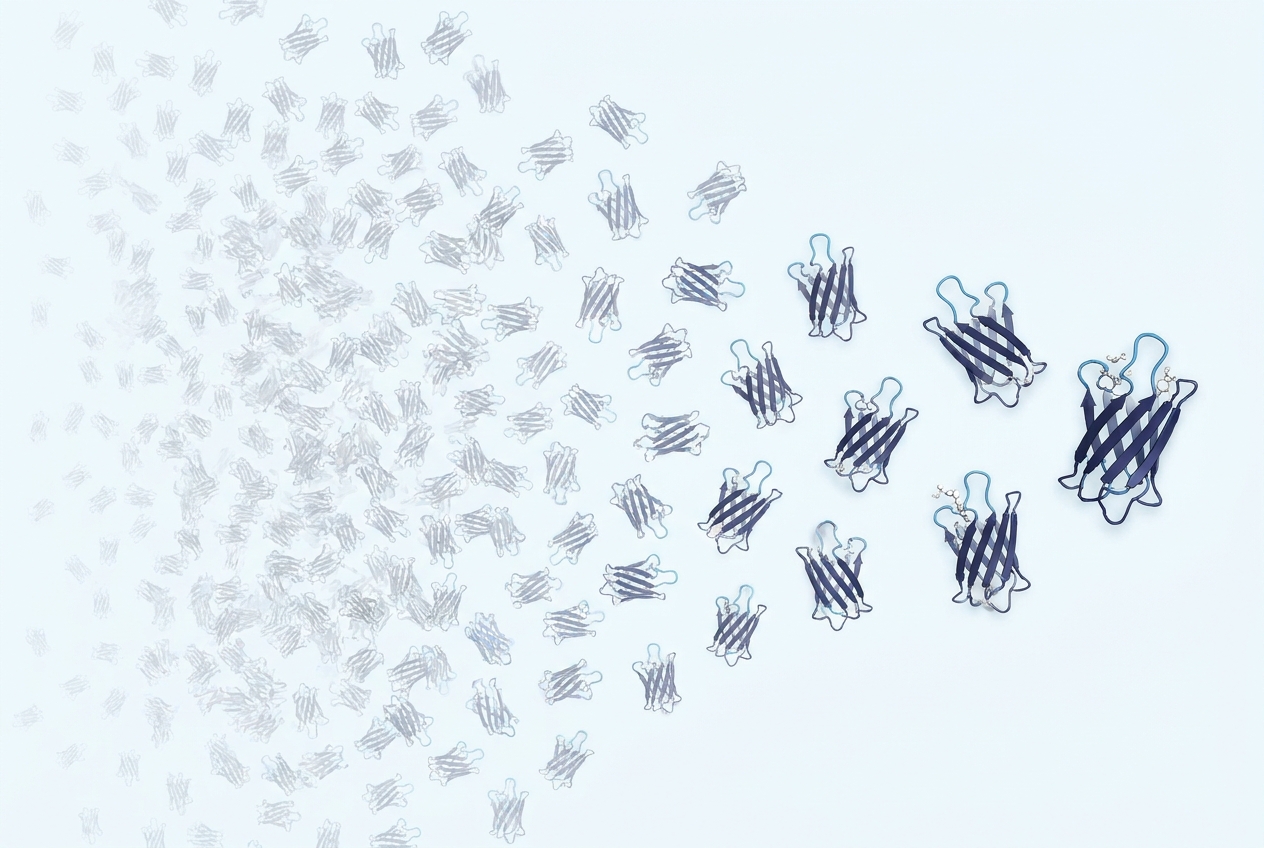
A de novo antibody design campaign looks like a funnel with a very wide mouth. On the campaign described here we generated 60 200 designs against a chosen epitope, retained 14 003 after removing known developability liabilities, selected 200 on contact quality, and delivered 129 candidates that passed an independent structural check. Every number in that sequence is an elimination, and the eliminations are the method rather than a by-product of it. What follows is that campaign in full, including the benchmark we measured ourselves against and the part the exercise does not establish.
A de novo antibody design funnel, with the real numbers
Four stages, each applying a single criterion:
- 60 200 designs generated: backbones are generated against the target structure at the epitope specified, and sequences are designed onto them. Generation is cheap, so there is no reason to be selective at this stage, and the breadth obtained here is what makes strictness possible later.
- 14 003 retained: sequences carrying a known developability liability are removed, before any consideration of affinity. The ordering is deliberate, because a candidate with a deamidation motif in a CDR will not survive development however well it scores on contact quality, and admitting it here only means arguing about it at a later stage.
- 200 selected: contact quality with the target decides this step: how the predicted interface is formed, which residues are engaged, and whether the paratope makes chemical sense against that particular surface.
- 129 candidates delivered: a second structural calculation, run independently of the design process that produced the molecules, so that a weakness cannot be concealed by the procedure that created it.
Each delivered candidate is therefore the survivor of four filters, one of which was applied by a different method from the one that generated it.
Benchmarked against a published campaign
Showing a funnel proves effort rather than results, so the campaign was run against a target where published experimental data exists.
An independent group ran a de novo design campaign against the IL-7 receptor alpha chain, a demanding immunological target. Fifteen computationally designed candidates were produced and characterised by surface plasmon resonance. Seven were confirmed binders, with dissociation constants ranging from single-digit nanomolar to a few hundred nanomolar, and the best clone in the panel measured 1.4 nM.
That is a 47% confirmed-binder rate among designs taken to the bench, against the few per thousand typical of conventional screening. We cite it precisely because the molecules belong to someone else, since a success rate that a company reports on its own work can be neither checked nor compared, whereas a published one can.
We then ran our own design campaign against the same target and kept 129 candidates. This turns the question into something verifiable: do our molecules resemble the ones whose binding was demonstrated, or the ones that failed?
The comparison is made on CDR3, which carries most of the paratope in a VHH. The framework is common to both sets, so overall sequence identity would carry no information.
- Against a confirmed binder, one of our candidates reproduced the CDR3 loop sequence identically across its full length, so the calculation arrived at exactly the sequence a laboratory had measured as binding.
- Against the best clone in the panel, the 1.4 nM binder, our closest candidate matched at eleven of thirteen positions. The two differences are substitutions by chemically similar residues, and our structural analysis places them on an outward-facing part of the molecule, away from the contact with the target.
- Against the candidates the laboratory reported as non-binders, the same exercise gives a markedly lower resemblance, and none of them approaches the level above.
The designs therefore converge on the molecules that worked while diverging from those that did not.
Why a second, independent structural calculation changes the ranking
Sequence resemblance is one line of evidence, and the quality of the predicted complex is a second, which needs an external reference before it means anything.
Our pipeline scores the predicted contact between each candidate and the target. To calibrate that score we ran it on 551 complexes whose structures have been determined experimentally. The spread is wide, and only 41% of those experimentally resolved complexes exceed the confidence threshold we impose, with a median of 0.65.
All 129 of our candidates sit above that threshold, with a median of 0.91.
The threshold was calibrated on those experimental complexes before our own molecules were scored against it, which is the only order in which the comparison carries weight.
What a de novo antibody design campaign establishes, and what it does not
We show that our design process arrives in the same sequence space as molecules whose binding has been measured, that it reproduces one of them exactly, and that our candidates score above a threshold calibrated on experimentally resolved structures.
We do not claim to have measured the affinity of our own candidates on this target. That measurement belongs at the bench and is the next step. We state the limit rather than leaving it to be discovered, and the general version of this argument is in our note on what a binding experiment proves.
Developability decided at design rather than repaired later
A molecule that binds but aggregates, degrades or fails to express is not a drug candidate. In a conventional campaign these defects surface late and are repaired by engineering, which is slow, expensive and sometimes costs affinity. Three choices made before the first molecule is drawn put the problem the other way round.
- The developability zone is documented experimentally: a reference study reconstructed 137 antibodies that had reached advanced clinical stage, 48 of them approved, and subjected them to a dozen biophysical measurements covering aggregation, self-association, polyspecificity, thermal stability and formulation behaviour. It establishes empirically the bounds that successful molecules do not cross. No single measurement predicts failure; the set of them traces the zone (Jain et al., PNAS 2017, 114:944-949, DOI, reference located through PubMed). That work was done on IgG1, so the equivalent for single domains matters more to us: a developability profiler calibrated on 36 clinical-stage nanobody sequences, with experimental data on 108 nanobodies expressed as IgG constructs, covering aggregation, polyreactivity, self-association and thermal stability (Gordon et al., Communications Biology 2026, DOI, reference located through PubMed). Published ranges therefore exist for this modality, and they are what we design into.
- The framework carries the stability: our candidates are built on a humanised VHH framework of the same kind as approved VHH therapeutics, and the choice is not cosmetic. A study of humanised synthetic VHH libraries measured by calorimetry what happens when CDRs are grafted from one framework to another. On one clinical framework, thermal stability was preserved or improved across the three donor domains tested: 63.3 °C against 63.6 °C for the grafted and original molecules in one pair, 78.3 °C against 77.8 °C in a second, and a gain in the third. On a second clinical framework, the same operation cost 9 to 11 °C. The same work reports that grafting reduced the affinity of the donor domains considerably, which is why framework choice is a design decision rather than a formality (Nakakido, Kinoshita and Tsumoto, Scientific Reports 2024, 14:19533, DOI, reference located through PubMed). The framework also influences the conformation of CDR3 itself, so beyond carrying the stability it shapes the recognition.
- Liabilities are excluded while the CDRs are designed: motifs known to cause problems in production, formulation or stability are removed at that point, so candidates carrying them are never proposed in the first place. The principle comes from the humanised synthetic libraries developed over the last decade, and we apply it to molecules drawn one at a time against a given target rather than to a randomised library. The wider case for this ordering is set out in developability by design.
What lands on your bench at the end of the campaign
A campaign of this kind delivers a panel of VHH candidates designed against your target and the region you specify, and with it:
- the predicted structure of the complex for each candidate, with a description of the contact;
- the prioritisation ranking, and the reason each candidate sits where it does;
- the developability file, covering the framework used, the motifs excluded and the final independent check;
- the sequences themselves, ready for production.
What computation changes is which molecules reach the bench. Where a conventional campaign tests hundreds of clones in order to keep a few, this approach produces a small number of molecules, each with a documented reason to be tested and none carrying a known developability liability.
Receive a feasibility study on your antigen - for free
Frequently asked questions
How many designs does a de novo antibody design campaign generate?
On the campaign described here, 60 200, reduced to 129 delivered candidates through four successive filters. Generation is inexpensive, so breadth at the start is what allows strictness at the end.
What is the success rate of de novo antibody design?
In the published independent campaign cited here, 7 of 15 designed candidates taken to the bench were confirmed binders by SPR, with the best at 1.4 nM. That is one campaign against one target, and difficulty varies substantially between targets.
Have your own candidates been tested experimentally?
Not on this target. What we show is convergence: our designs land in the same sequence space as measured binders, reproducing one CDR3 loop exactly and matching the best clone at eleven of thirteen positions, while diverging from the reported non-binders.
Why filter developability before affinity?
Because the reverse order creates a choice nobody wants: engineer a liability out of a selected lead and risk the affinity you selected for, or carry the problem forward. Removing liable sequences at the second stage costs nothing, since they are only sequences at that point.
Why run a second structural calculation?
So that a weakness cannot be hidden by the process that produced it. The final check is run separately from the design pipeline, and the threshold it applies was calibrated on 551 experimentally resolved complexes rather than on our own molecules.
Can I see the full methodology?
The methodological detail and the complete structural analyses are available on request, under a confidentiality agreement.
Want this run against your target?
Receive a feasibility study on your antigen - for free