How do you extend the half-life of a VHH: VHH-Fc or albumin binder?
Below roughly 60 kDa the kidney filters a protein out within hours. For an imaging tracer that is the point. For a drug dosed every few weeks it is the problem to solve, and the way you solve it changes the molecule more than most format decisions do.

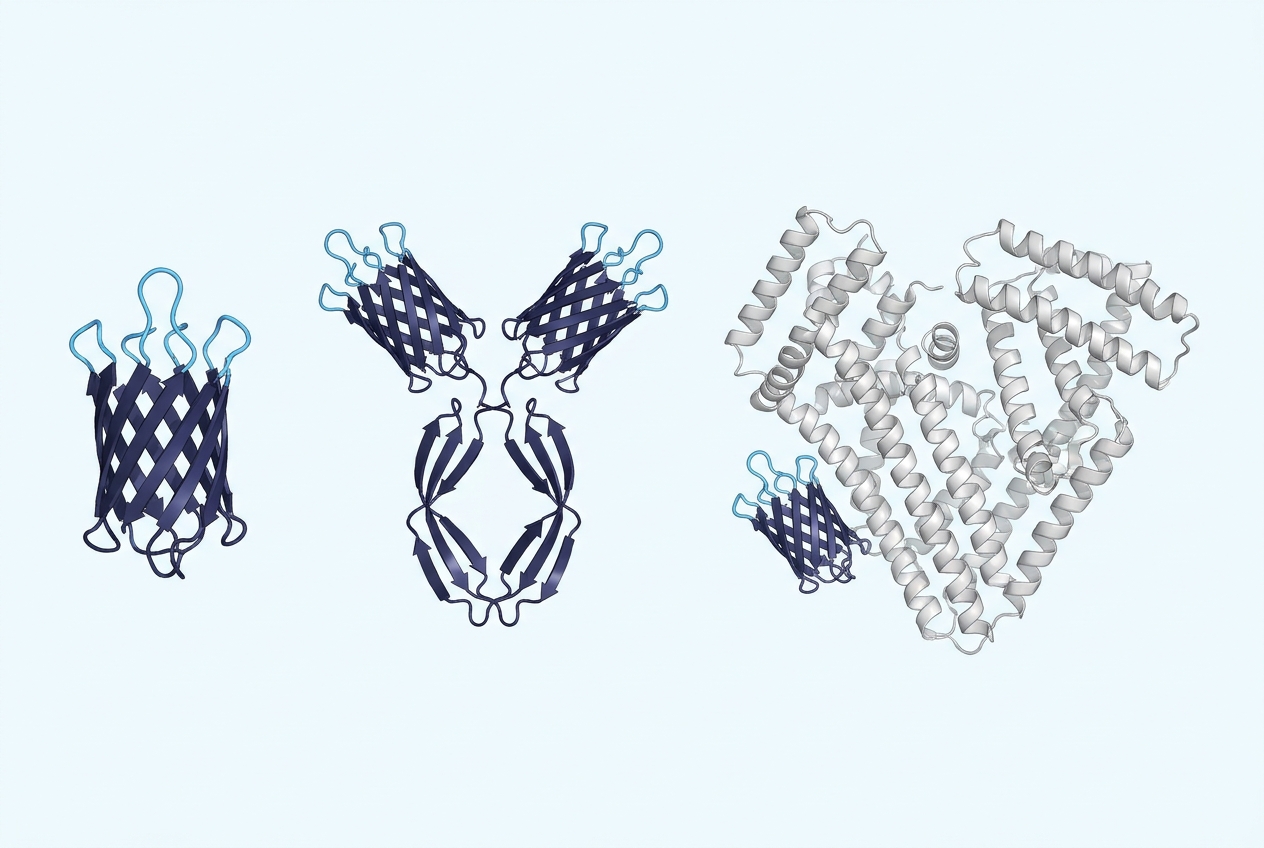
A bare VHH is around 15 kDa, well below the roughly 60 kDa threshold at which the kidney filters a protein out of circulation, so it clears within hours. The two usual answers to that are a VHH-Fc fusion and an albumin-binding module, and they are not interchangeable. Whether the problem needs solving at all depends on what the molecule is for: for an imaging tracer, fast clearance is the reason you chose a single domain in the first place; for a therapeutic dosed every few weeks, it is the first thing to fix. They change the molecule in different ways, and the choice is worth making deliberately rather than by default.
Why a bare VHH clears in hours, and a VHH-Fc does not
Glomerular filtration removes small proteins from blood efficiently. The cutoff is not sharp, and it sits in the region of 60 kDa for a globular protein, modulated by shape and charge. At 15 kDa a VHH is far below it.
The consequence is a serum half-life measured in tens of minutes to a few hours, against weeks for an IgG. Size is only part of the difference: an IgG is both too large to filter and actively recycled through the neonatal Fc receptor, FcRn, which rescues it from degradation and returns it to circulation. A bare VHH has neither property.
That is the mechanism, and it points directly at the two ways of changing it: get above the filtration threshold, or acquire FcRn recycling. The available options do one, the other, or both.
A clinical precedent makes the trade-off concrete. Caplacizumab is a bivalent VHH with no half-life extension at all, and it is dosed daily (Scully et al., New England Journal of Medicine 2019, 380:335-346, DOI, reference located through PubMed). The indication is acute, which is the context in which a short-lived molecule is straightforward to stop.
When fast clearance is the feature you want to keep
For a substantial share of applications, fast clearance is the reason the format was chosen, so it should not be treated as a problem by default.
- Imaging and radiolabelled tracers: the signal depends on the contrast between target and background, and the background falls as unbound tracer clears. A long-lived tracer keeps the background high and prolongs the patient's exposure, so fast clearance is the design goal.
- Inhaled and topical products: the molecule acts where it is applied, and systemic exposure is unwanted.
- Local administration: intratumoural, intra-articular or intraocular delivery, where residence at the site is what matters and circulation is beside the point.
- Research reagents and diagnostics: in vitro, half-life is irrelevant.
For all of these, extending half-life makes the product worse, and the question arises only for systemic therapeutics.
VHH-Fc, albumin binder or PEG: what each option costs you
- Fc fusion: the VHH is genetically fused to the Fc region of a human IgG. The construct dimerises to roughly 80 kDa, which puts it above the filtration threshold, and the Fc engages FcRn so that the molecule is recycled, moving half-life from hours towards the weeks typical of an IgG. Three consequences come with it. The construct is bivalent, which raises avidity and may be an advantage or a complication depending on whether crosslinking the target is wanted. Effector functions return, since the Fc engages Fcγ receptors and complement, which serves a cytotoxic mechanism and has to be engineered out for a blocking one. And the molecule now requires mammalian expression and a full antibody-style characterisation package, which gives up most of the manufacturing advantage of a small single domain.
- Albumin binding: a second module that binds serum albumin is fused to the VHH, often itself a VHH. Albumin is abundant, long-lived and recycled through FcRn, so the construct is carried along with it. The result is smaller than an Fc fusion, typically 25 to 30 kDa, with no effector function and no bivalency unless they are added deliberately. The extension is substantial while generally falling short of an Fc fusion, and it depends on the affinity of the albumin-binding module and on cross-species differences in albumin, which complicates the interpretation of animal data.
- Direct albumin fusion: fusing to albumin itself rather than to a binder, which produces a large construct in which the added module is inert.
- PEGylation and other chemical modification: increases the hydrodynamic radius by physical rather than biological means. Effective, with its own regulatory and immunogenicity considerations, and it adds a chemical conjugation step.
- Multimerisation alone: linking two or three VHHs raises both mass and avidity while usually leaving the construct close to the filtration threshold, which makes it a way of gaining avidity rather than a dependable way of gaining half-life.
| Bare VHH | Albumin binder | VHH-Fc | |
|---|---|---|---|
| Approximate mass | 15 kDa | 25 to 30 kDa | 80 kDa |
| Serum half-life | Hours | Days | Towards weeks |
| Mechanism | None | Carried by albumin, FcRn recycled | Above filtration, FcRn recycled |
| Effector function | None | None | Yes, unless engineered out |
| Valency | Monovalent | Monovalent unless multimerised | Bivalent |
| Tissue penetration | Highest | Good | Reduced |
| Expression | Bacterial, yeast, cell-free | Bacterial, yeast | Mammalian |
| Characterisation burden | Low | Moderate | Antibody-like |
What a VHH-Fc inherits from the VHH it is built on
The useful property of a single domain here is that the binding unit and the format are largely separable. A VHH that binds well can be reformatted into a bivalent construct, an Fc fusion or an albumin-binding fusion without redesigning the paratope, which is one of the reasons it is a convenient starting point when the final format is not settled. This is the same argument made in our comparison of VHH, scFv and IgG formats.
Separable does not mean free, and three things carry over:
- Epitope accessibility can change: a site that a 15 kDa domain reaches comfortably may prove harder for an 80 kDa dimer, particularly where it is recessed. If access to a cleft was the reason for choosing a single domain, adding an Fc may remove the very advantage you were buying.
- Avidity changes the pharmacology: a bivalent construct against a target that can be crosslinked behaves differently from a monovalent one, sometimes usefully and sometimes not.
- Developability has to be reassessed: a fusion is a new molecule, and liabilities at the junction, in the linker, or arising from the combination itself do not appear in an assessment of the domain alone. The general case is set out in developability by design.
The practical order is therefore to settle the application first, since it decides whether half-life is a problem at all, then design the binding domain, and only then choose the format, knowing that the choice will carry its own characterisation work.
Where our work stops
The binding domain is one piece of work and the final construct is another. What a design campaign delivers is VHH sequences designed against the site you specify, filtered on developability and tested for binding after cell-free expression, as described in our note on what a binding experiment proves. At Immunochem that runs to six weeks to candidate sequences and twelve weeks to binders validated in the laboratory.
Reformatting into a VHH-Fc, an albumin-binding fusion or a multimeric construct is the stage that follows, and the construction, expression and characterisation of the fusion belong to you or to a provider set up for it. We will give you our view on which option suits your application, and raising the question early matters, because it bears on which epitope is worth engaging in the first place.
Receive a feasibility study on your antigen - for free
Frequently asked questions
What is a VHH-Fc?
A single-domain antibody genetically fused to the Fc region of a conventional IgG. The construct dimerises to roughly 80 kDa, which puts it above the renal filtration threshold, and the Fc engages FcRn for recycling, giving a half-life approaching that of an antibody. It also restores effector function and makes the molecule bivalent.
How long does a bare VHH last in circulation?
Tens of minutes to a few hours, because at around 15 kDa it is well below the roughly 60 kDa threshold for glomerular filtration and has no FcRn recycling.
Is an albumin binder better than an Fc fusion?
Neither is better in general. An albumin binder keeps the molecule small, avoids effector function and keeps better tissue penetration. An Fc fusion gives the longest half-life, adds bivalency and restores effector function. The choice should follow the mechanism you need rather than the half-life figure on its own.
Does adding an Fc affect binding?
Not the paratope itself, but it can affect access. A larger, bivalent construct may reach a recessed epitope less easily than a bare domain, and avidity changes the apparent behaviour against a crosslinkable target.
Can you decide the format later?
Largely, yes, which is an advantage of the single-domain format. The binding domain can be reformatted without redesign. What cannot be deferred is the question of whether the epitope you chose still works in the final format.
Do you supply VHH-Fc constructs?
No. We design and validate the binding domain. Reformatting and its characterisation are a separate stage, and we will give you our view on which option suits your application.
Still deciding on a format?
Receive a feasibility study on your antigen - for free