Miniproteins or VHH: which one should you design for a research or diagnostic assay?
A miniprotein is designed from nothing, a VHH is a natural architecture with CDRs designed into it. The first is smaller and cheaper to make, the second has decades of precedent behind it. Which matters depends on whether the binder is a reagent or a candidate.

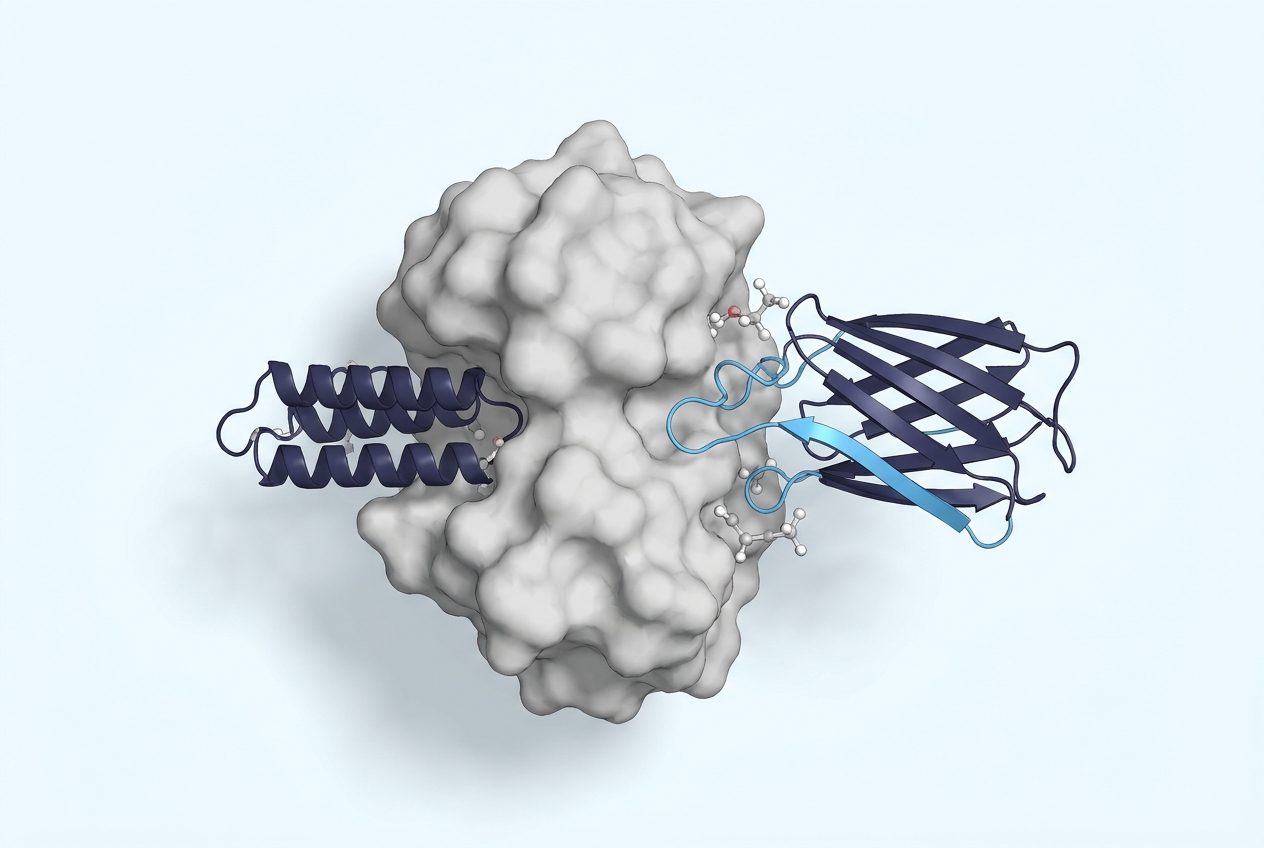
A miniprotein is a small designed protein, typically under 100 amino acids and between 1 and 10 kDa, built from a fold that need not exist in nature. A VHH is a natural architecture of about 15 kDa with designed loops placed onto a conserved framework. Both can now be designed computationally against a chosen site, which makes them real alternatives for the first time. For a research reagent or a diagnostic assay the choice usually comes down to three things: how small you need it, how much precedent you need behind it, and how the binder will be produced and attached to whatever it has to work with.
What a miniprotein is, and how it differs from an antibody domain
Miniproteins occur naturally in venoms, where small disulfide-stabilised scaffolds are common, and the designed versions borrow the principle rather than the sequences. A typical designed miniprotein is a compact bundle of helices or a small mixed fold, stabilised by its packing or by disulfides, with no immunoglobulin architecture at all.
The design freedom is the point. There is no framework to respect and no loop geometry inherited from an immune system, so the binding surface can be shaped to the target rather than fitted into a paratope.
The field has moved quickly. De novo designed miniproteins targeting G-protein-coupled receptors, a class long considered among the hardest, have been reported with high affinity, potency and selectivity, with cryo-electron microscopy structures of five receptor-bound designs matching the computational models closely, and one designed chemokine receptor antagonist mobilising haematopoietic stem and progenitor cells in vivo at a level comparable to a clinically used drug (Muratspahić et al., Nature 2026, 656:1044-1053, DOI, reference located through PubMed).
That is a significant result, and it required a dedicated high-throughput screening method developed alongside the design work. The designs did not go straight from computer to confirmed binder.
Miniprotein against VHH: the main differences
| Miniprotein | VHH (nanobody) | |
|---|---|---|
| Architecture | Designed fold, no natural template required | Natural single domain, designed CDR loops |
| Typical size | 1 to 10 kDa, under 100 residues | About 15 kDa, around 120 residues |
| Binding surface | Shaped freely to the target | Convex paratope, extended CDR3 |
| Stability | Often very high, disulfide or packing stabilised | High, refolds after denaturation |
| Expression | Bacterial, cell-free, or chemical synthesis at the small end | Bacterial, yeast, cell-free |
| Clinical precedent | Early, no approved product | Approved therapeutics, established route |
| Reformatting | Bespoke, no standard toolkit | Fc fusion, multimerisation, CAR domains, all routine |
| Detection reagents | Few standard anti-format reagents | Anti-VHH secondary reagents widely available |
| Immunogenicity | Novel sequence, limited data | Framework close to human VH3, humanisation routine |
| Design maturity | Rapid progress, strong recent results | Published experimental validation, antibody-specific tooling |
For a research reagent or a diagnostic assay
This is where the comparison is most practical, and where the usual therapeutic arguments do not apply.
- Size is a real advantage for miniproteins: in a densely labelled assay, on a sensor surface, or anywhere steric crowding limits how many binders fit, a 5 kDa molecule behaves differently from a 15 kDa one. For super-resolution microscopy the linkage error matters directly.
- Production cost favours miniproteins at the small end: below a certain length chemical synthesis becomes an option, which takes biology out of the supply chain altogether. Above it, both formats express well in bacteria.
- Stability is strong for both, and this is where single domains and designed miniproteins alike outperform conventional antibodies for reagents that have to survive handling, shipping and storage.
- Ecosystem favours VHHs, often decisively: Anti-VHH secondary reagents, capture resins, tag systems and established conjugation chemistries all exist and are catalogued, whereas for a miniprotein each of them becomes a bespoke problem. Where an assay depends on a detection sandwich or on a standard secondary, this can settle the question on its own.
- Reformatting favours VHHs: making a binder bivalent, fusing it to an enzyme or turning it into a CAR domain are routine operations with a single domain and bespoke work with a miniprotein.
For anything heading towards a clinic
Precedent weighs more heavily than performance here, and it currently favours VHHs.
Approved VHH-based therapeutics exist, the regulatory path has been walked, and the immunogenicity question has data behind it. Designed miniproteins have none of that yet: every sequence is novel, the fold may not resemble anything a human immune system has encountered, and the class has no approval precedent. The GPCR work above is strong science, but it is a research result rather than a clinical track record.
Half-life is a problem for both, and a worse one for miniproteins. Both sit well below the renal filtration threshold, so both clear in hours. For a VHH the fixes are established and discussed in our note on extending a VHH's half-life. For a miniprotein there is no standard toolkit.
In summary, miniproteins are an active and promising research modality, while for a therapeutic programme today a single domain carries less risk that has nothing to do with how well the molecule binds.
The measurement problem that applies to both formats
One limitation deserves stating because it is rarely mentioned in comparisons of designed binders.
Affinity and off-target behaviour are harder to establish for designed binders than the published success stories suggest. Predicted interface quality ranks candidates against each other without yielding a dissociation constant, and off-target behaviour against a novel fold has no prior expectation to be compared with. The practical consequence is that campaigns depend on producing and screening more candidates than the computational step alone would imply, which is the general argument in what a binding experiment proves.
This is why the GPCR work needed a screening method of its own, and it is a reason to treat any binder in either format with caution when it arrives with scores and no measurements.
How to decide, in three questions
For an assay or a reagent, three questions usually settle the matter faster than any comparison of folds: what the binder has to attach to, whether a detection ecosystem already exists for the format, and whether the size constraint is real or merely assumed. For a therapeutic programme, precedent and the availability of a half-life toolkit tend to decide it.
Immunochem designs single-domain antibodies and conventional antibodies, and the tooling we run is antibody-specific, covering framework selection, CDR design and developability profiling calibrated on single domains. Miniproteins are a modality we are assessing rather than one we sell, and we have built no commercial offer around them. Where a target and an application would be better served by a miniprotein, we will say so rather than fitting the problem to what we already do.
Receive a feasibility study on your antigen - for free
Frequently asked questions
What is a miniprotein?
A small protein, usually under 100 amino acids and between 1 and 10 kDa, with a stable tertiary structure. Natural ones occur in venoms. Designed ones are built computationally and need not resemble any natural fold.
Is a miniprotein the same as a nanobody?
No. A nanobody is an immunoglobulin domain of about 15 kDa with the natural VHH architecture. A miniprotein is smaller and has no antibody architecture. Both can be designed computationally against a chosen site, which is why they are now compared.
Which is better for a diagnostic assay?
It depends on the constraint. Miniproteins are smaller and can be chemically synthesised at the small end. VHHs have an ecosystem of secondary reagents, resins and conjugation chemistries that usually matters more in practice than a few kilodaltons.
Are miniproteins used as drugs?
Not yet as approved products. Research is advancing quickly, including designed miniproteins targeting GPCRs with structures confirming the design models and in vivo activity. For a therapeutic programme today, formats with clinical precedent carry less regulatory risk.
Do you design miniproteins?
Our tooling is antibody-specific and our offer is built around single-domain and conventional antibodies. Selling miniprotein campaigns is a separate line we are still assessing. The free feasibility study, on the other hand, covers a miniprotein target in a day or two exactly as it does a VHH one, and part of what it returns is which of the two formats the target is better suited to.
Have a reagent or assay target and are unsure which format fits?
Receive a feasibility study on your antigen - for free